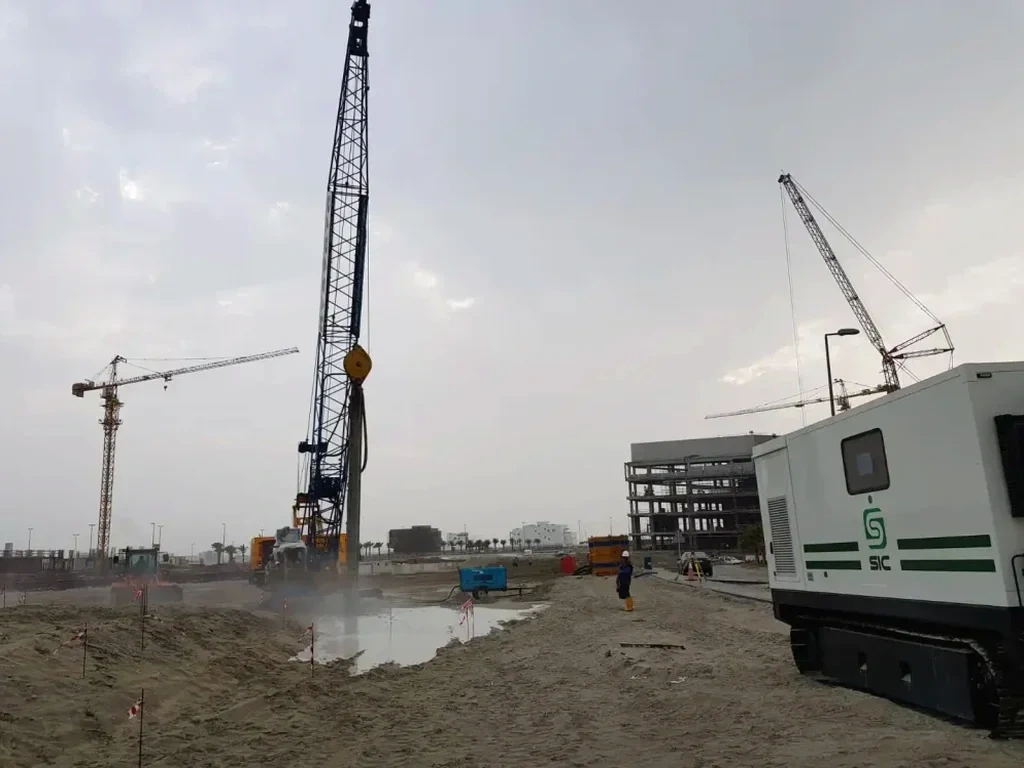
NZS 3404 and the NZGS ground improvement guidelines set a clear framework for deep compaction, yet the variability of Whangarei's geology demands more than a generic design. The city sits on a mix of estuarine sediments, basalt-derived residual soils, and pockets of loose pumiceous sand, particularly around the Hatea River flats and the port reclamation. When a site investigation flags SPT N-values below 10 in the upper 6 metres, we don't just plug numbers into a spreadsheet. Our team correlates the data with the specific fines content of Whangarei sands — often higher than what you'd see in the Canterbury Plains — and adjusts the compaction grid accordingly. A well-tuned vibrocompaction design here prevents differential settlement that can tear apart industrial slabs and tank foundations before the first year of operation is out. We often cross-check the target density with a pre-construction CPT test to calibrate the cone resistance against the relative density we need to achieve, because relying on SPT alone in silty sand can be misleading.
Effective vibrocompaction in Whangarei is about tuning the energy to the local silty sand — not just hitting a generic relative density target.
Local geotechnical context
The ground behaviour between the Kamo clay uplands and the Hatea River flats couldn't be more different, and a vibrocompaction design that works on the well-drained volcanic slopes is useless on the loose estuarine sands downtown. The biggest risk we see is treating a site as uniform when it's actually a mosaic of cut and fill. If you compact the fill zone but leave a lens of natural loose sand untreated beneath a corner of the foundation, you've created a hinge point. Cracking follows. Another common issue in Whangarei is underestimating the effect of a high water table, often sitting just 1.5 m below ground level in the winter months. Compaction-induced pore pressure can build up quickly in silty material, reducing effective stress and temporarily softening the ground before it consolidates. Our designs include pore pressure dissipation checks and, where needed, staged compaction with rest periods. Ignoring this turns a ground improvement programme into a ground disturbance programme.
Questions and answers
What does vibrocompaction design cost for a Whangarei site?
For a typical commercial or industrial site, the design package — including desktop study, CPT correlation, design report, and verification protocol — runs between NZ$2,150 and NZ$8,190, depending on the treatment area and complexity of the ground profile.
How does the high water table in Whangarei affect vibrocompaction?
A shallow water table, common in the river flats and port area, helps the compaction process by reducing inter-particle friction, but it also means pore pressures can spike during treatment. Our designs account for this with staged passes and dissipation monitoring so you don't lose effective stress mid-treatment.
Can vibrocompaction be used near existing buildings in Whangarei?
It depends on the structure's condition and foundation type. We assess the vibration attenuation path and typically maintain a setback of 6–10 metres from sensitive structures. In tighter spots, we can specify low-frequency start-up and a reduced energy profile to keep peak particle velocity within safe limits.