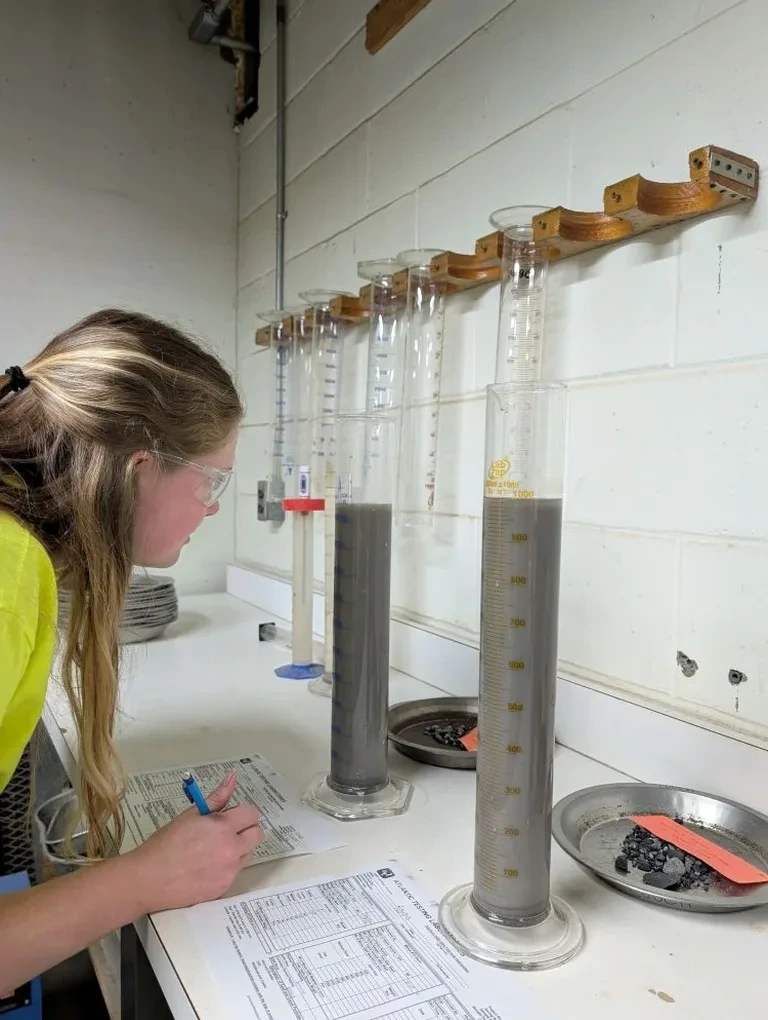
A recent industrial subdivision out near Kioreroa Road hit trouble right at the subgrade stage. The site investigation logs looked fine on paper, but the compacted fill was pumping under the roller. The contractor called us in mid-panic. We ran a laboratory CBR test on a remoulded sample at the target density, and the number came back at 3 percent. Three. That explained everything. The volcanic ash-derived clay had lost all strength once moisture content crept above optimum. We adjusted the lime stabilisation ratio based on a second round of CBR specimens, and the pavement design went ahead without ripping up the formation. That scenario repeats itself across Whangarei because the geology shifts so abruptly—from firm basalt residuum in Tikipunga to soft alluvium along the Hatea River. A standard penetration test tells you one story. The laboratory CBR test tells you how the material actually behaves under confinement and water. For pavement engineers, that distinction is the difference between a road that lasts twenty years and one that rutts in two seasons. When the subgrade is borderline, we often pair CBR data with a CPT test to correlate continuous strength profiles without excessive sampling.
A soaked CBR of 3 percent on Whangarei volcanic clay can turn into 15 percent with the right lime dose—but you need the test to prove it.
Method and coverage
NZS 4404:2010 drives most pavement design in the Whangarei District, and it leans heavily on soaked CBR values. The logic is straightforward: Northland gets over 1,300 millimetres of rain a year, so any unbound granular layer sits wet for long periods. A CBR test run at optimum moisture tells you nothing about field performance. We soak the specimen for four days, apply the standard surcharge rings, and then measure penetration resistance with the plunger at 1.27 millimetres per minute. The load-penetration curve gets corrected for surface irregularities, and we report CBR at 2.5 and 5.0 millimetres—taking the higher value unless the curve shape triggers the NZTA correction rules. Most local materials fall into the CBR 3 to 8 range untreated. With 2 percent cement or 3 percent hydrated lime, that number often jumps past 15. We run the Proctor compaction first to lock in the density target, then mould the CBR specimen at the specified compactive effort. The whole sequence—compaction, soak, penetration—takes about five working days. If the project timeline is tight, we can run unsoaked CBR in parallel for immediate construction control, then follow with soaked results for the design record.
Local geotechnical context
Whangarei's post-war expansion pushed housing and light industry onto land that earlier surveyors had marked as swamp or fern-covered flats. The 1960s subdivisions around Raumanga and Onerahi filled gullies with whatever material was closest—weathered basalt, pumiceous silt, demolition rubble. Sixty years later, those fills are reaching the end of their service life under traffic loads they were never designed for. Pavement failures show up first as crocodile cracking in the asphalt, then as depressions after heavy rain. The root cause is almost always subgrade saturation and strength loss. A laboratory CBR test on a Shelby tube sample from below the fill reveals the true bearing capacity of the natural ground. If the CBR is below 3 percent, even a thick granular overlay will not save the pavement without some form of stabilisation or geosynthetic reinforcement. We have seen this pattern repeat on Whangarei District Council roads, private access ways, and car park subgrades. The test itself is straightforward, but skipping it is the most expensive mistake a developer can make on these soils. Moisture sensitivity of Northland clays is extreme—they can lose 60 percent of their soaked strength within a 2 percent change in water content.
Questions and answers
What does a laboratory CBR test cost in Whangarei?
A standard soaked CBR test, including Proctor compaction to establish the moulding density, runs between NZ$230 and NZ$390 per specimen depending on whether it is a single-point or three-point series. Most pavement investigations need three specimens at minimum to capture the moisture-density-strength relationship, so budget around NZ$800 to NZ$1,100 for a complete set.
How long does a soaked CBR test take from sample to report?
Five working days is the minimum for a soaked CBR. The Proctor compaction takes one day, specimen moulding another, then the four-day soak under surcharge. We run the penetration test on day five and issue the report the same afternoon. Unsoaked CBR for construction control can be turned around in 24 hours if the material is already at target moisture.
Do you test both field samples and remoulded specimens?
Yes. Remoulded specimens are the standard because pavement construction recompacts the subgrade. We compact the material at the specified Proctor effort to simulate field conditions. When a client needs to understand the in-situ strength of an existing formation, we take undisturbed Shelby tubes and test them in the lab, though this is less common for pavement design than for foundation assessment.
What CBR value does Whangarei District Council require for residential roads?
Under NZS 4404:2010, the minimum soaked CBR for a residential subgrade is typically 5 percent at formation level. If the natural ground tests below that, the council will ask for a stabilisation design or a thicker aggregate layer. We have seen multiple subdivisions in the Glenbervie and Maunu catchments where lime modification was needed to lift the native clay from CBR 3 to above 5.