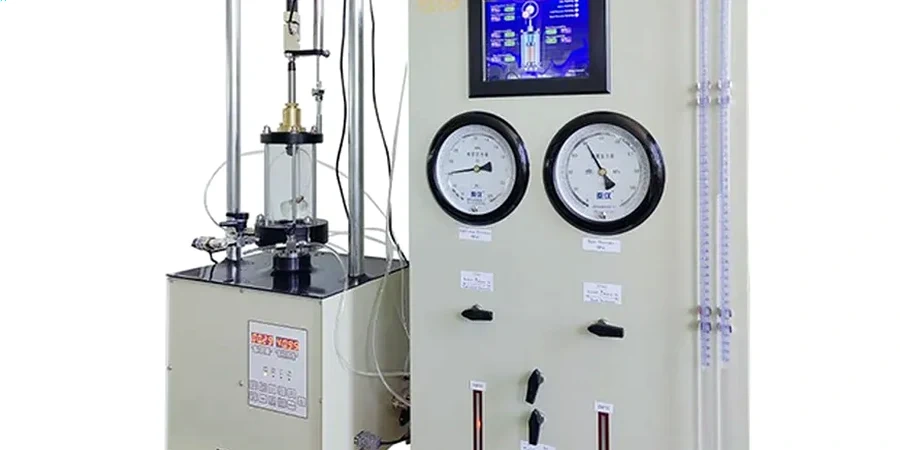
In Whangarei, where the landscape transitions from volcanic ridges to soft alluvial flats near the Hatea River, the assumption of uniform soil behavior is the quickest path to a failed foundation. The city’s geology, shaped by Northland’s complex tectonic history, frequently presents contractors with residual soils derived from weathered greywacke and basalt, materials whose strength cannot be reliably inferred from simple index tests alone. When a developer is placing a multi-story structure on the reclaimed margins of the Town Basin, the effective stress parameters must be measured, not estimated. This is where the triaxial test becomes indispensable, providing the nuanced data required to model how Whangarei’s heterogeneous soils will actually perform under the combined loads of a building and the region’s frequent heavy rainfall events. Complementing field investigations like the CPT test with a laboratory program that includes triaxial testing ensures that the design profile is calibrated against the true undrained shear strength, significantly reducing the financial risk of over-conservative earthworks or the safety risk of an under-designed retaining structure.
A single triaxial test on an undisturbed Whangarei clay sample can reveal a brittle failure plane that an SPT correlation would completely miss, preventing a costly under-design of earthworks.
Local geotechnical context
Consider a four-level apartment building designed for the Kamo Road corridor, where the geotechnical report from a desk study assumed a generic friction angle from a textbook. The site sat on a lens of highly plastic, fissured clay derived from the local Northland Allochthon, a material prone to strain-softening when sheared. Without a triaxial test quantifying the residual strength, the foundation’s bearing capacity was overestimated by nearly 40%, a discrepancy that only became apparent when a neighboring excavation triggered a minor slump in the shared boundary. The project was halted for eight weeks while a remediation design involving piles socketed into the underlying competent rock was prepared and consented, a delay that could have been avoided entirely with a targeted advanced testing regime. The Whangarei District Council’s consenting engineers are increasingly scrutinizing the robustness of shear strength parameters, especially for structures over three stories, because the cost of a test is negligible compared to the professional indemnity exposure of a foundation failure in compressible soils with a history of slope instability.
Questions and answers
What is the typical turnaround time for a consolidated undrained triaxial test in your Whangarei laboratory?
For a standard consolidated undrained (CIU) triaxial test with pore pressure measurement, the typical turnaround is 10 to 14 working days from the receipt of an undisturbed sample. This timeframe accounts for the slow saturation and consolidation stages, which are critical for obtaining reliable effective stress parameters. Expedited scheduling can be arranged for projects facing tight consenting deadlines with the Whangarei District Council.
What is the cost range for a triaxial testing program in Northland?
A standard triaxial test program in Whangarei, involving a set of three specimens to define the failure envelope, typically ranges between NZ$2,730 and NZ$4,970 depending on the complexity of the testing stages and the required consolidation stress range. This is a specialized testing procedure, and the final cost reflects the technical time involved in saturating and shearing the samples over several days.
Can you perform triaxial tests on coarse Whangarei gravels from the volcanic formations?
Standard triaxial testing is designed for fine-grained soils, but we can test the matrix material of weathered rock and gravels by using larger specimen diameters, typically up to 100mm. For the coarse, clean gravels found in the Horahora area, a large-scale direct shear test or a field plate load test is generally more appropriate to capture the particle interlock effects.
How do you ensure the sample retains its in-situ moisture during transport from a Whangarei site?
Undisturbed samples are sealed in the field immediately upon extrusion from the Shelby tube using multiple layers of microcrystalline wax and plastic wrap. The samples are then packed in rigid foam-lined crates and transported within 24 hours to the Whangarei laboratory, where they are stored in a controlled humidity room at 100% relative humidity to prevent any moisture loss before the triaxial specimen is trimmed.