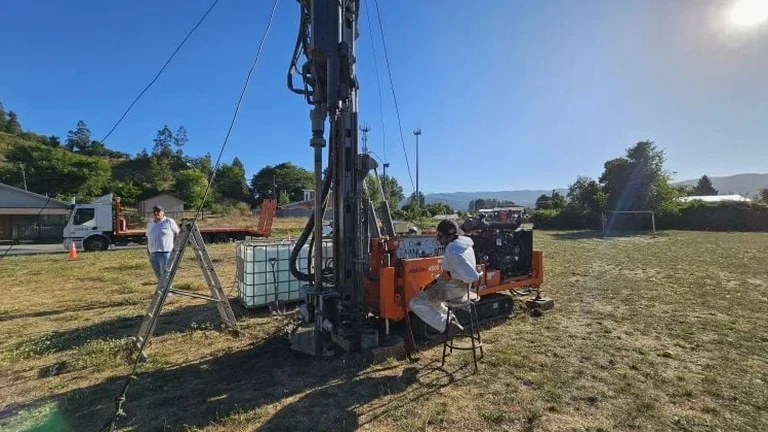
In Whangarei, a borehole log alone often misses what’s right at the surface — buried fill, old tree roots, or a lens of pumiceous silt that turns to slurry in the rain. That’s why we still open exploratory test pits when the ground story matters. A pit puts eyes on the strata. You see the transition from topsoil into weathered basalt or stiff alluvial clay, you measure the exact depth to water seepage, and you take bulk samples where a split-spoon would only smear the fines. The Whangarei District sits on a mix of Northland Allochthon rocks, young volcanics, and harbour sediment; test pits let us map that variability in metres, not in extrapolation from a single point. Before footing geometry gets locked in, the Atterberg limits from a pit sample tell the structural engineer exactly how the clay will behave when wetted.
A test pit turns subsurface guesswork into a measured section you can photograph, sample, and defend to the consent authority.
Local geotechnical context
The most common mistake we see on Whangarei sites is assuming that a building platform scraped flat is uniform ground. A thin skin of clay can hide an old rubbish pit, a buried stump hole, or a pocket of uncompacted fill that’s been there since the 1970s subdivision. If the test pit isn’t dug deep enough — or worse, skipped entirely — the foundation ends up bearing on material that hasn’t been seen, let alone tested. Later, differential settlement shows up as cracked slabs, and the cost of remediation dwarfs what the investigation would have cost. On sites near the Hatea River or the harbour edge, undocumented fill containing organic silt can generate methane; we’ve hit that twice this year alone. The pit gives you a direct look at the material, a gas reading if needed, and the chance to change the foundation level before the concrete goes in.
Questions and answers
What does an exploratory test pit cost in the Whangarei area?
For a standard machine-dug pit with logging, sampling, and photo record, budget between NZ$840 and NZ$1,600 depending on depth, access, and whether we run lab index tests on the samples. Sites that need traffic management or long-reach excavators fall at the upper end.
How deep can you go with a test pit in Whangarei soils?
We typically stop between 3.5 m and 4.5 m, or earlier if the batter becomes unsafe or groundwater inflow destabilises the face. In the volcanic clays around Maunu and Kamo, cohesive soils can stand near-vertical for a short window, but we always follow Worksafe NZ shoring guidelines.
Do I need council consent just to dig a test pit?
Generally no resource consent is required for a temporary investigation pit that is backfilled the same day, but you must check district plan earthworks thresholds and any archaeological overlays. We handle Worksite Access Permits when the pit is within the road corridor.
What lab tests do you run on test pit samples?
The most common suite is moisture content, Atterberg limits, and a particle size distribution by sieving. If we suspect organic content, we request loss on ignition. For bearing capacity analysis, we often add a triaxial or direct shear test on undisturbed block samples taken from the pit floor.
How soon can you be on site in Whangarei?
We can usually have an excavator and geologist on site within three to five working days, faster if the job is straightforward and we’re already mobilised in the Northland region. Contact us with the address and a site plan and we’ll lock in a date.