← Home · Seismic

Base Isolation Seismic Design in Whangarei: NZS 3404 Compliance & Site-Specific Analysis

Together, we solve the challenges of tomorrow.

LEARN MORE →

A four-storey medical centre proposed for the Kamo Road corridor faced a fundamental design challenge: proximity to the Whangarei Fault and a subsoil profile dominated by compressible alluvial silts overlying basalt at variable depth. Conventional fixed-base design predicted inter-story drifts exceeding serviceability limits under a 500-year return period event. The engineering solution required a shift to base isolation seismic design, integrating lead-rubber bearings tuned to the site-specific spectra derived from deep seismic refraction profiles. Whangarei's transitional tectonic setting—between the active Hikurangi subduction margin and the relatively stable Northland Allochthon—demands a nuanced approach. Ground motions here are not simply a scaled version of the Christchurch or Wellington records; the volcanic geology modifies wave propagation in ways that generic code spectra cannot capture. Our team executed a comprehensive geotechnical investigation to characterise the dynamic soil properties required for the isolator manufacturer's prototype testing protocol.

In Whangarei's volcanic terrain, the spectral acceleration at 1.0 second period often governs isolator displacement, not the short-period plateau—an inversion of typical North Island response spectra.

Methodology and scope

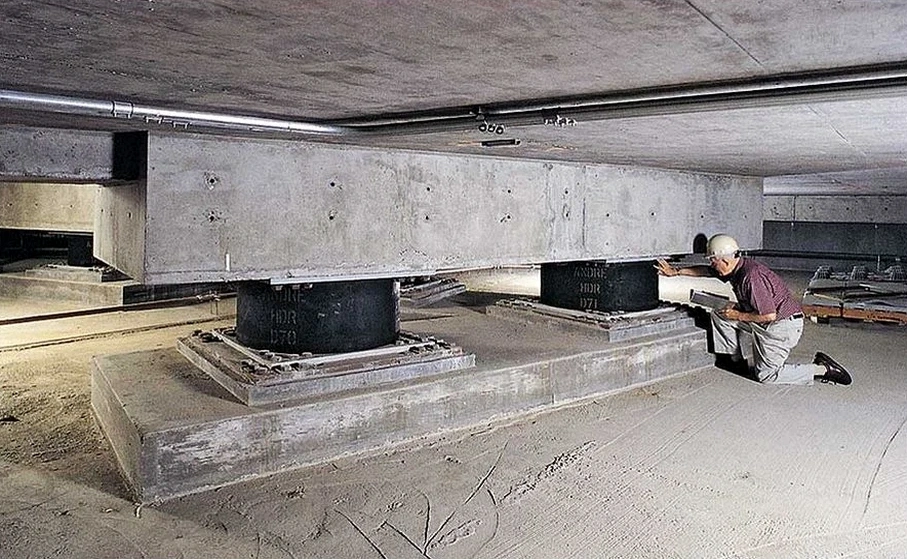
The isolator units specified for Whangarei projects are typically high-damping rubber bearings or lead-rubber bearings with a design displacement capacity calibrated to the near-fault pulse characteristics of the local seismicity. Each unit consists of alternating layers of natural rubber and steel shim plates, vulcanised under heat and pressure to form a compact device that supports vertical load while permitting lateral movement of up to 400 mm in the design basis earthquake. The lead core yields plastically during a seismic event, converting kinetic energy into heat and providing a damping ratio of 15 to 30 percent. For a recent project on Maunu Road, we supervised the plate load testing of the isolator pedestal foundations to confirm the bearing stratum could sustain the concentrated vertical reactions without excessive settlement. The manufacturing tolerances demand that plinth levels be set within plus or minus 3 mm across the entire footprint—a quality control target that requires continuous survey verification during the casting sequence.
Base Isolation Seismic Design in Whangarei: NZS 3404 Compliance & Site-Specific Analysis
Technical reference image — Whangarei

Local geotechnical context

Whangarei's subtropical climate introduces a corrosion risk not present in drier parts of New Zealand. Isolators installed below ground level in a basement moat are exposed to relative humidity exceeding 90 percent for extended periods, and condensation cycles accelerate the degradation of the rubber cover layer if the protective coating is compromised during installation. The Whangarei District Council's consenting process requires a durability plan demonstrating how the isolator units will be inspected and maintained over the building's design life—this is not a discretionary item. A more insidious geotechnical hazard arises from the lens of soft peat and organic clay mapped near the Hatea River floodplain. Even with an isolation interface, differential settlement of the supporting piers can misalign the isolators, locking in eccentricity that reduces the effective damping and increases the torsional response of the superstructure. Our investigation protocols include cone penetration testing through the upper 15 metres to identify any compressible lenses that might compromise the foundation rigidity beneath the isolation plane.

Need a geotechnical assessment?

Reply within 24h.

Email: [email protected]

Typical values

ParameterTypical value
Design life of isolator units50 years minimum per NZS 3404:1997 Amendment 2
Typical effective damping ratio (lead-rubber)15–30% of critical
Maximum considered earthquake (MCE) displacement250–450 mm depending on site subsoil class
Isolator vertical load capacity (single unit)500–12,000 kN
Post-elastic stiffness ratio0.10–0.15 for standard LRB configurations
Wind restraint threshold forceCalculated per NZS 1170.5 Section 8; typically 2–3% of seismic weight
Moat cover live load rating5 kPa minimum or fire engine access load where applicable

Other technical services

01

Site-specific seismic hazard and response spectra development

Probabilistic and deterministic seismic hazard analysis incorporating the Whangarei Fault, Wairoa North Fault, and Hikurangi subduction interface sources. Site response analysis using equivalent-linear or non-linear soil models to generate surface spectra per NZS 1170.5 Section 6.

02

Isolator prototype testing supervision and design review

Witness testing at the manufacturer's facility to verify that the force-displacement hysteresis loops meet the project specifications under the three-prototype test protocol. Review of the production quality control documentation including shear modulus batch testing of the rubber compound.

03

Moat detail design and waterproofing specification

Design of the seismic gap and moat covers to accommodate the maximum considered earthquake displacement plus an allowance for accidental torsion. Specification of the waterproofing membrane system rated for the design displacement cycle count and the local groundwater chemistry.

Regulatory framework

NZS 1170.5:2004 Structural design actions – Earthquake actions, NZS 3404:1997 Steel structures including Amendment 2 provisions for seismic isolation, NZS 4203:1992 General structural design and design loadings (for legacy compatibility checks), NZGS Module 1: Earthquake geotechnical engineering practice, AS/NZS 1170.0:2002 Structural design actions – General principles

Questions and answers

What is the cost range for a base isolation seismic design package for a Whangarei commercial building?

For a medium-scale commercial structure in Whangarei, the full design package—including site-specific hazard analysis, geotechnical investigation, isolator specification, and peer review coordination—typically falls between NZ$6,110 and NZ$14,220. The final figure depends on the number of isolator units, the complexity of the soil profile, and whether non-linear time-history analysis is required by the peer reviewer.

How does NZS 3404 address the testing requirements for lead-rubber isolators?

NZS 3404:1997 Amendment 2 references the testing regime now fully detailed in AS/NZS 1170 parts. The standard requires a minimum of three full-scale prototype tests per isolator type: one for the design basis earthquake displacement, one for the maximum considered earthquake, and a third for the wind restraint verification. The hysteresis loops must demonstrate stable energy dissipation over three consecutive cycles with no more than a 20 percent degradation in effective stiffness.

Is base isolation feasible on the soft alluvial soils found near the Whangarei town basin?

Feasibility depends on the depth to competent bearing stratum. Where basalt or Waitemata Group sandstone is within 10 to 15 metres, piled foundations can support the isolator pedestals with sufficient rigidity. In deeper soil profiles, a rigid raft or interconnected beam grid is required to prevent differential movement. We routinely specify CPT profiling to map the stiffness contrast between the alluvial layer and the underlying rock, which directly influences the foundation design.

What maintenance do base isolators require in Whangarei's humid environment?

The inspection regime follows the manufacturer's recommendations, typically biennial visual checks of the rubber cover for cracking, measurement of the isolator's residual displacement, and verification that the moat is free of debris. In Whangarei's humidity, we specify a polyurethane-based protective coating with UV stabilisers and require a dehumidification strategy for enclosed basement moats to keep the relative humidity below 75 percent.

How does the Whangarei District Council consenting process handle base isolation?

The council treats base isolation as a specifically engineered design requiring a Producer Statement (PS1) from the structural engineer and a peer review by an independent chartered professional engineer with experience in seismic isolation. The peer reviewer's scope includes verification of the site-specific spectra, the isolator design parameters, and the non-linear analysis model. Allow six to eight weeks for the peer review cycle in the project programme.
Location and service area

We serve projects in Whangarei and surrounding areas.

View larger map