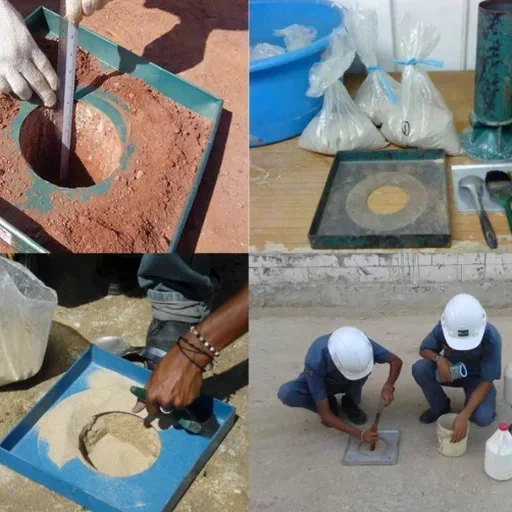
Whangarei's geology shifts fast: basalt flows from the Parahaki and Maunu scoria cones sit right next to soft alluvial silts along the Hatea River, and weathered Waitemata Group sandstone underlies much of the city basin. When a compactor rolls over these mixed materials, the achieved density can vary more than the contractor expects. Our lab team runs the sand cone field density test across Northland to verify that compaction meets the spec before the next lift goes down. In the Whangarei CBD rebuild area and out at the Marsden Point extension, we couple this with CPT testing when the sand cone becomes impractical below 300 mm depth, and we review results against grain size distribution to confirm whether the fill itself matches the laboratory compaction curve.
A density ratio of 98% on a lab curve means nothing if the fill material on site has changed — we check both in the same shift.
Questions and answers
How much does a sand cone density test cost in Whangarei?
For projects within the Whangarei urban area and out to Kamo, Onerahi, and Tikipunga, a single sand cone test typically runs between NZ$150 and NZ$250 per point, depending on the number of tests booked and travel distance to the site. A morning of five to eight tests on one subdivision brings the per-test cost down noticeably.
How many tests do I need per lift on a residential section?
The Whangarei District Council usually requires a minimum of one test per 200 m² per compacted lift, with at least three tests per layer regardless of area. For trench backfill under services, one test per 20 linear metres is common. We confirm the exact frequency against your consent conditions before starting.
Can you test through coarse scoria or large aggregate?
The sand cone method works best with particles up to about 20 mm. On Whangarei's coarse scoria fills where the maximum particle size exceeds that, we enlarge the test hole and use a replacement sand with a calibrated unit weight suited to the larger volume. If the aggregate is too open-graded for a reliable sand cone, we discuss switching to a plate load test for modulus-based acceptance.
What happens if the test fails the compaction spec?
We give you the numbers on the spot: wet density, moisture content, and the dry density ratio against the lab curve. If it's under spec, we flag the likely cause — moisture too high, lift too thick, or roller passes insufficient — so the earthworks crew can rework the layer. We'll retest after recompaction, and we keep the paperwork chain ready for the engineer's sign-off.