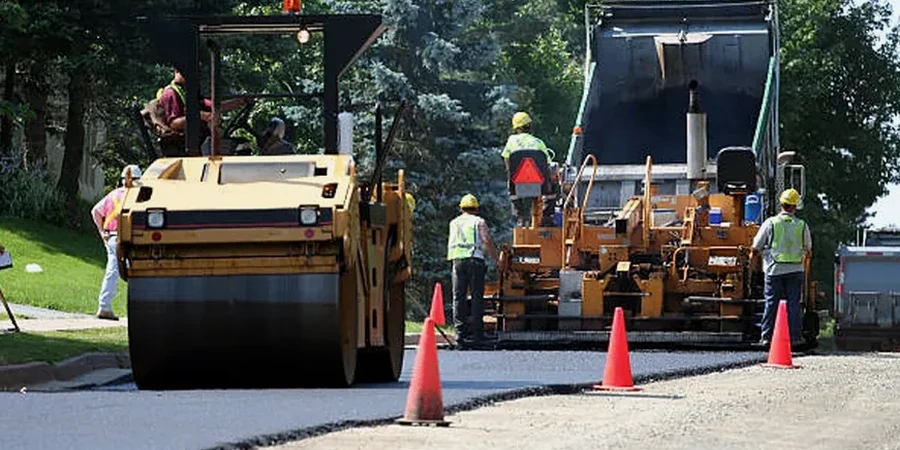
The roading network across Whangarei District contends with a geologically young landscape where basaltic lava flows from the Puhipuhi-Whangarei fields meet deep alluvial deposits along the Hatea River. Designing a flexible pavement here means confronting residual clays that turn greasy after 2000 mm of annual rainfall, then harden to near-rock stiffness during a dry summer. Our approach to flexible pavement design integrates falling-weight deflectometer verification with laboratory testing of subgrade moisture sensitivity, ensuring that the granular layers and bituminous surfacing work as a single system rather than as stacked independent courses. For sites near the Town Basin or over reclaimed estuarine muds, we often recommend coupling the pavement analysis with a plate load test to confirm the modulus of the treated subgrade before placing the first aggregate layer.
A well-designed flexible pavement in Whangarei distributes wheel loads so effectively that the subgrade never experiences stress beyond its resilient modulus, even after a cyclonic rain event.
Local geotechnical context
The difference in flexible pavement design risk between a site in Onerahi, sitting on soft Mangakahia Complex sandstone, and one in Maunu, overlying firmer volcanic breccia, is stark. Onerahi's subgrade can lose 70% of its bearing capacity within hours of a sustained downpour if the pavement drainage is under-designed, leading to deep-seated rutting that requires full-depth reconstruction. In Maunu, the same rainfall event might only generate minor surface flushing because the volcanic subgrade drains internally. The most expensive mistake we see is applying a standard Whangarei District Council cross-section without investigating the subgrade variability across the site. A pavement that survives 20 years on volcanic ground can fail in five over alluvium if the formation is not proof-rolled and tested at the correct moisture condition.
Questions and answers
What thickness of flexible pavement do I need for a residential driveway in Whangarei?
For a standard residential driveway accessing a single dwelling, Whangarei District Council typically accepts a minimum of 150 mm of well-graded basecourse over a stabilised subgrade, provided the subgrade CBR exceeds 5%. If you are on the softer alluvial soils near the city centre or Raumanga, the granular layer may need to be increased to 200-250 mm. We confirm the exact thickness after a site visit and a few dynamic cone penetrometer tests at formation level.
How much does flexible pavement design cost for a commercial car park?
For a commercial car park or light-industrial yard in the Whangarei area, the pavement investigation and design package ranges from NZ$2,580 to NZ$8,070. The spread depends on the number of boreholes or test pits required, whether we need to run FWD testing, and the complexity of the stormwater drainage integration. A small car park on competent scoria might fall at the lower end, while a larger facility over reclaimed ground near the town basin will require more intensive investigation.
Do you use the Austroads or the AASHTO method for pavement design?
We use the Austroads mechanistic-empirical framework, which is the standard adopted across New Zealand and referenced in NZS 4404. The method models the pavement as a multi-layer elastic system and calculates the critical strains at the base of the asphalt and top of the subgrade. We calibrate the models using local Whangarei material properties from our own laboratory testing rather than relying on generic Austroads default values, which gives you a more accurate fatigue and rutting life prediction for Northland conditions.
Can you design a flexible pavement over a high water table without using full-depth asphalt?
Yes, we do it regularly for projects in low-lying areas of Whangarei like the lower Hatea floodplain. The key is installing a capillary break layer of clean, open-graded aggregate directly above the subgrade, coupled with edge drains that discharge positively to a stormwater system. We also increase the design subgrade CBR by conditioning the formation with a small percentage of cement or hydrated lime. This approach avoids the cost of full-depth asphalt while keeping the granular layers drained and structurally competent through the wettest months.