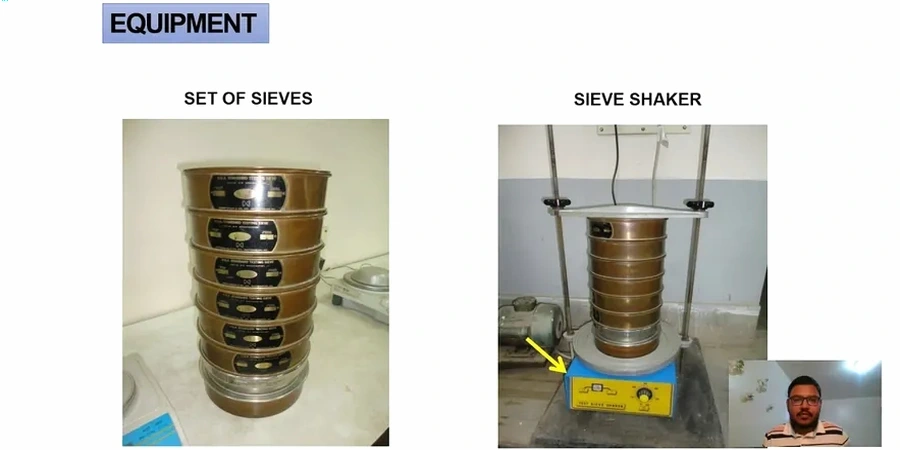
A standard sieve stack isn't enough in Whangarei. The basalt-derived residual soils across Kamo, Tikipunga, and the Hatea River basin produce fines that control compaction behaviour, permeability, and slope stability. We run the complete NZS 4402 suite: dry/wet sieving through 63 mm down to 75 µm, then hydrometer on the minus 75 µm fraction. The transition from free-draining scoria layers to tight silty clay at depth shows up immediately in the gradation curve. For pavement subgrade projects, we combine grain size analysis with CBR testing to correlate fines content with bearing capacity loss after wetting. On pumice-rich horizons near the airport, the hydrometer reading demands careful deflocculant selection — standard sodium hexametaphosphate sometimes over-disperses the altered glass shards, yielding an artificially high clay fraction.
Fines content above 15% in a Whangarei subgrade means we run the hydrometer — the difference between 8% clay and 18% clay determines whether lime stabilisation works.
Local geotechnical context
Two sites in Whangarei, 3 km apart, can give completely different gradation curves. The alluvial flats near the Town Basin carry well-graded sandy gravels from the Hatea River — excellent for drainage, Cu values above 6, no hydrometer needed. Move upslope into the weathered basalt terrain around Kensington, and you encounter gap-graded silty sands with 25-35% fines, Cu below 3, and a hydrometer curve that doesn't settle for 24 hours. If the spec says 'well-graded granular fill' and the lab reports only the sieve fraction, you miss the 18% clay fraction that turns the fill into a pudding during Northland's winter rainfall. We report the full combined curve because the gap between the 75 µm sieve and the 2 µm clay fraction is where Whangarei's earthworks problems hide. A material that sieves as clean sand can still pump water under compaction if the hydrometer reveals a colloidal tail.
Questions and answers
What does a combined grain size analysis cost in Whangarei?
For a standard combined sieve and hydrometer test compliant with NZS 4402, budget between NZ$180 and NZ$360 per sample. The price depends on the number of sieve sizes requested, whether the sample needs washing before sieving, and the hydrometer reading interval density. Bulk discounts apply for quarry QC programmes with 20+ samples per month.
Why run a hydrometer analysis on what looks like clean sand?
Visual classification is unreliable in Whangarei's volcanic soils. A sand that sieves clean can still carry 8-12% colloidal fines that don't register on the 75 µm sieve but dramatically reduce permeability. The hydrometer quantifies the clay fraction — if it exceeds 5%, the material may not meet free-draining fill specification even if the sieve curve looks good.
How much sample do you need for a full gradation test?
For material with maximum particle size up to 20 mm, we need about 2 kg. If the material contains cobbles up to 63 mm, the required mass jumps to 25-35 kg to ensure a representative split. We follow the minimum sample mass table in NZS 4402 Test 6.1. Our team can advise on sampling procedure before you dig — a poorly taken sample invalidates the entire analysis regardless of lab precision.
Can you use grain size data to assess liquefaction susceptibility?
Grain size is one input, not the complete answer. We plot the gradation curve against the Tsuchida (1970) liquefaction susceptibility boundaries to flag potentially liquefiable materials. In Whangarei's silty sands near the Hatea estuary, the D50 and fines content often fall inside the 'most liquefiable' band. However, a full liquefaction assessment also requires SPT or CPT data, groundwater depth, and seismic hazard parameters — grain size alone is insufficient for a design-level evaluation.